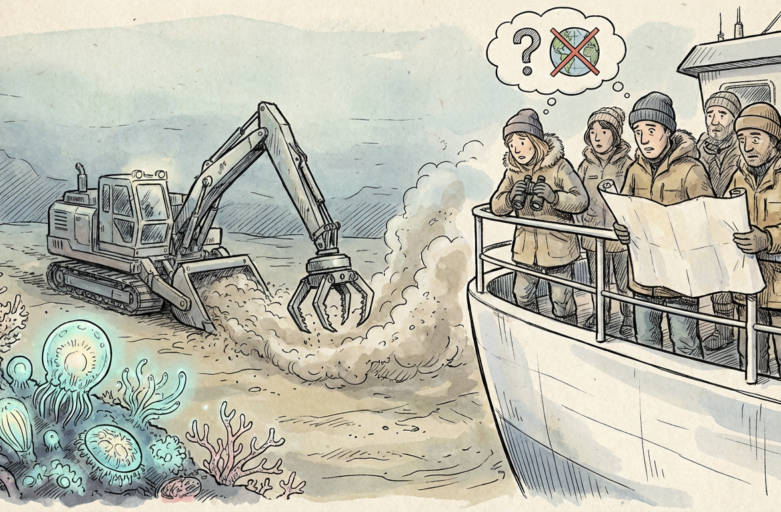
Most coverage of ocean science gets it backwards. The real story isn’t about discovery for its own sake—it’s about deep sea mining companies rushing to extract resources before we even know what’s down there. And marine biologists are sounding the alarm.
What makes this different from past environmental debates is the sheer scale of our ignorance colliding with industrial urgency. We’re essentially arguing over the future of places we’ve never seen. That’s not just ironic—it’s dangerous.

The Communication: Setting the Terms
Here’s the number that should make you uncomfortable: 80 percent of Earth’s oceans remain unexplored and unmapped at high resolution. This isn’t just a cool fact for trivia night. It’s the fundamental problem that makes every other ocean policy debate feel premature.
Think about it this way. Mining companies want to scrape the seafloor for metals while scientists are still finding 2,000 new species per year down there. It’s like arguing over development rights to a continent we’ve only seen from airplane windows. MBARI ocean research has been documenting this mismatch between industrial timelines and scientific understanding.
Three years ago, deep sea mining felt like science fiction. Today, companies have permits and equipment. The science hasn’t caught up—it’s fallen further behind. We’re discovering new ecosystems at the same time we’re planning to destroy them.
I keep coming back to this tension because it’s where the real story lives. The popular narrative focuses on the wonder of discovery, the “alien world beneath the waves.” But the urgent story is about time running out before we can even catalog what we’re losing.
Ocean acidification at the fastest rate in 300 million years just adds urgency to the whole mess. We’re changing these environments faster than we’re studying them.
The Misconception Correction: The Analysis
The speed of ocean acidification tells you everything about how we approach ocean science. We measure what’s easy to measure and call it progress. Meanwhile, the hard questions get pushed aside until it’s too late to ask them properly.
Consider what it means that we found plastic pollution in the Mariana Trench at 11 kilometers depth. The surveys started in 2019—this isn’t old news we’re just hearing about. We’re finding human waste in places we’ve barely visited. That should change how we think about “pristine” deep ocean environments.
But here’s where it gets more complex. Autonomous underwater vehicles are transforming research speed and cost in ways that previous generations of ocean scientists couldn’t imagine. We can explore more, faster, and cheaper than ever before. The technology is finally catching up to the scale of the problem.
The frustrating part is timing. We developed these capabilities just as the pressure to exploit the deep ocean reached a tipping point. It’s like getting glasses right before someone turns off the lights. NOAA Ocean Service tracks these technological advances, but the data shows we’re still playing catch-up.
There’s also a fairness issue nobody talks about. Rich countries and corporations get first access to deep sea resources while the science—which benefits everyone—gets underfunded. We socialize the knowledge but privatize the profits. That’s not sustainable, and it’s not smart.
Implications: What This Means If You Care About Popular science myths
The ocean science story connects to bigger problems with how we handle scientific uncertainty. We act like incomplete knowledge means no knowledge, then use that as an excuse to postpone difficult decisions.
Here’s what I think matters most: discovering 2,000 new species per year from deep ocean surveys isn’t just interesting—it’s a warning signal. Each new discovery shows how much we don’t know. At this rate, we’re always going to be discovering more than we’re protecting.
The practical question becomes: how do you make policy in a state of massive ignorance? The current approach—let industry move first, study the consequences later—is exactly backwards. We should be requiring comprehensive baseline studies before any extraction permits.
But let’s be honest about the constraints. Deep ocean research is expensive, technically challenging, and takes years to produce usable results. Politicians and investors work on shorter timelines. That mismatch isn’t going away.
A few things seem clear regardless of how you feel about the politics. First, deep sea mining is happening whether scientists are ready or not. Second, plastic pollution reaching the deepest ocean trenches means nowhere is unaffected by human activity. Third, the organizations treating this as a temporary controversy are going to be surprised by how persistent these conflicts become.
The Case Against: What the Critics Get Right
I should acknowledge the strongest argument against the “study first” approach: we might not have time. Climate change and resource scarcity create real pressure to develop alternative supply chains quickly.
The counter-argument goes like this: finding 2,000 new species per year could continue indefinitely without ever producing actionable knowledge for policy makers. Perfect information is impossible, and waiting for it guarantees paralysis. Some risk is unavoidable.
There’s truth in that. The 80 percent of unexplored ocean won’t be mapped tomorrow, no matter how much funding we throw at it. Meanwhile, land-based mining is causing documented environmental damage right now. Deep sea mining might be the lesser evil.
The regulatory concern is also real. If deep ocean research reveals ecosystems that are impossible to mine around, we might lock ourselves out of resources we desperately need. Industry argues for learning by doing rather than studying forever.
These aren’t bad-faith arguments. The challenge is that autonomous underwater vehicles and improved survey technology are making comprehensive baseline studies possible for the first time. We’re not asking for decades of delay—just enough time to understand what we’re affecting.
Looking Forward
I can’t predict exactly when the collision between mining timelines and scientific understanding will reach crisis point. But I’m confident it will happen, and probably sooner than most people expect.
Autonomous underwater vehicle deployment is the metric I watch most closely. It moves faster than policy changes, and it determines how quickly we can fill knowledge gaps. The technology is improving exponentially, but so is the pressure to begin extraction.
Three questions help me think about what comes next. Are we building research capacity fast enough to inform policy decisions? Who benefits if we rush forward, and who pays the costs of mistakes? What would convincing evidence of serious harm look like, and would we recognize it in time?
The honest answer is that we’re conducting a massive experiment with systems we don’t understand. That might be unavoidable—but we should at least admit what we’re doing and monitor the results carefully.
The current moment in ocean science feels like a test case for how we handle complex, uncertain, high-stakes decisions. So far, we’re not doing great. But the tools for doing better exist if we choose to use them.
What other science misconception needs this treatment?